
Read Stephens County Deed Records
Each instrument goes to the Clerk of Superior Court. That is the core of the Stephens County deed records. A deed names the parties, describes the land and states the form of conveyance, while related security deeds, liens and plats sit in neighboring index systems and answer different questions.
| Deed Type | What It Does | Common Use |
|---|---|---|
| Warranty deed | [Full ownership with guarantees] | [Standard sales] |
| Quitclaim deed | [Transfers whatever interest exists] | [Family, divorce, cleanup] |
| Grant / special warranty | [Limited guarantees] | [Some sales, Georgia custom] |
| Trustee / executor deed | [Transfer from an estate or trust] | [Probate, foreclosure] |
| Tax deed | [Transfer after a tax sale] | [Delinquent-tax properties] |
Warranty deeds convey ownership with stated covenants. Quitclaims pass only whatever interest the grantor happens to hold, without those assurances. Security deeds secure debt rather than transfer ownership outright, and fiduciaries such as administrators or executors may sign instruments tied to estates. Always read the document itself.
Navigate the Stephens Grantor-Grantee Index
Party searching starts online. The GSCCCA real-estate index lets you search recorded grantors and grantees statewide by county, date and instrument type. Stephens entries begin January 1, 1990. Check the portal's own coverage notice for the current end date, since the index rolls forward as the clerk records new instruments.
- Find the likely current acquisition deed with the owner as grantee.
- Read its grantor, recording date, legal description and book/page or instrument reference.
- Search that grantor as an earlier grantee and confirm the land description remains continuous.
- Repeat backward; use courthouse books, microfilm and predecessor counties when online coverage ends.
- Grantor
- [The party transferring - the seller.]
- Grantee
- [The party receiving - the buyer.]
- Chain of title
- [The ordered sequence of deeds for a property.]
- Book/Page vs Instrument #
- Alternative citations that return to a recorded document; copy whichever the index supplies.
Search GSCCCA by Party and Instrument
| Field | How to use it | Why it matters |
|---|---|---|
| County | Select Stephens | Avoids statewide same-name matches |
| Party name | Try person and entity variants | Finds grantor or grantee entries |
| Instrument type | Narrow to the relevant deed class | Separates conveyances from other filings |
| Date range | Bracket the likely transfer | Reduces a common-name result set |
| Book/page | Use a known deed citation | Returns directly to an indexed record |
Index entries are viewable online. Images and printing may carry account charges, so try spelling variants, initials, trustee wording, estate forms and business names in both party roles.
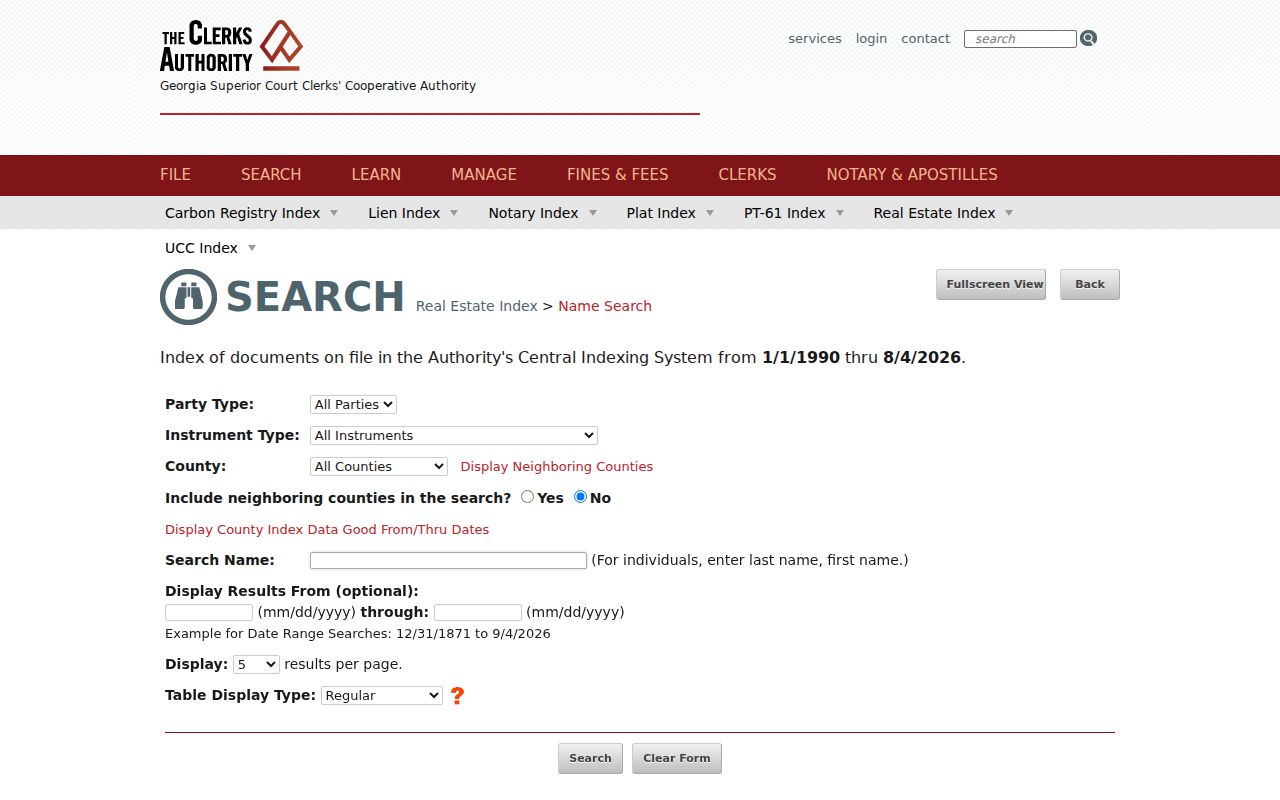
A result row is only an index lead. The official GSCCCA form displays the statewide search controls you will use to reach the underlying deed.
Use Book, Page and Subdivision Routes
A citation beats a guess. A known book and page takes you directly to the GSCCCA book/page search. A subdivision name offers another route. The property form requires it, and it adds county, date and page controls. These routes shine when a party's name changed or a common surname floods the results.
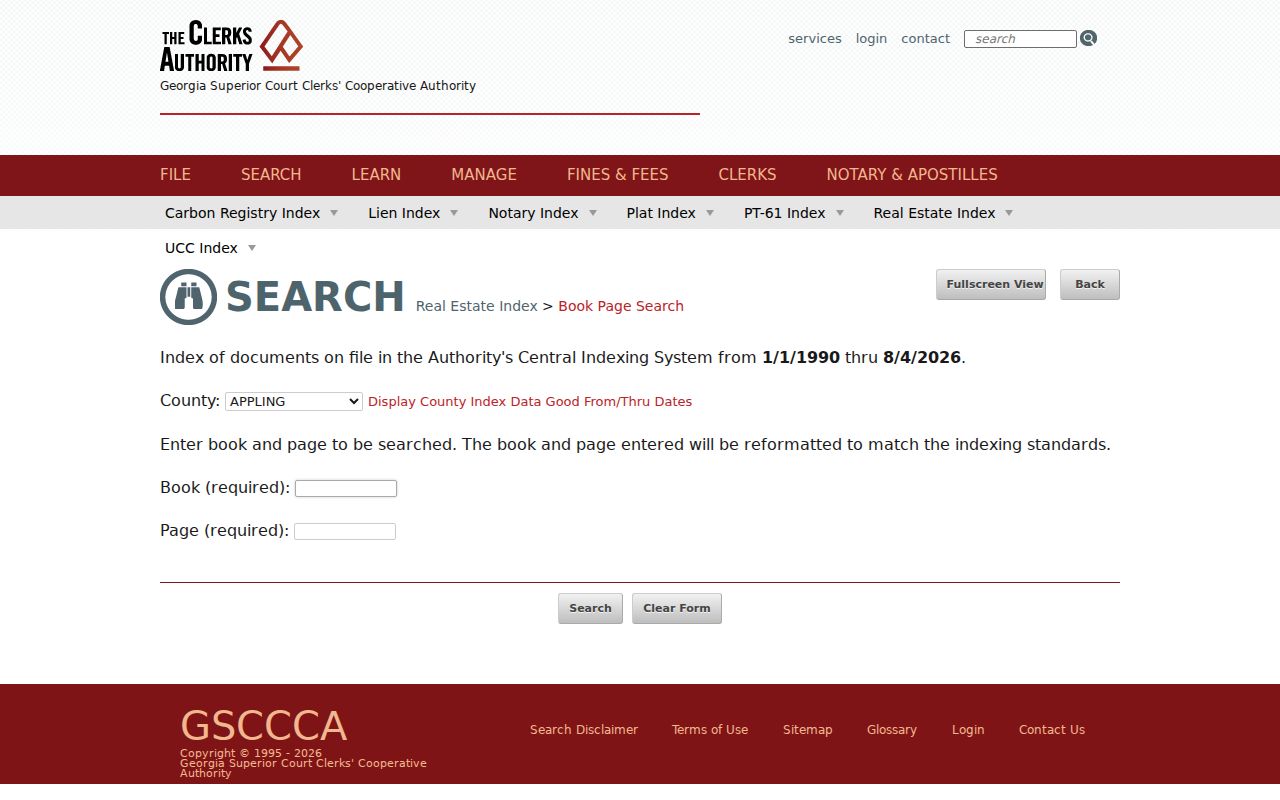
Preserve every character. Keep the book type, leading characters and page exactly as displayed, and treat a subdivision label as a search clue rather than proof of a municipal boundary or the current legal description.
Account for PT-61 and Transfer Tax
Many Georgia transfers carry a PT-61 form. It reports transfer-tax details to the state. Stephens County guidance sets the transfer tax at $1 for each $1,000 of value. That figure helps interpret a conveyance. Read it with care. Do not convert the figure casually into present value, or assume every recorded instrument reflects an arm's-length sale; compare the PT-61 trail against the deed date, recording date, parties and legal description. Family, estate, corrective and entity transfers often need context beyond a price-like field.
Follow Plats and Legal Descriptions
A chain lives or dies on the land description. A street address that repeats across decades proves little. Stephens deeds and plats may identify a subdivision, lot and block, land lot and district, or metes-and-bounds calls. When an index clue is not enough, use the GSCCCA plat search and request the recorded plat from the clerk.
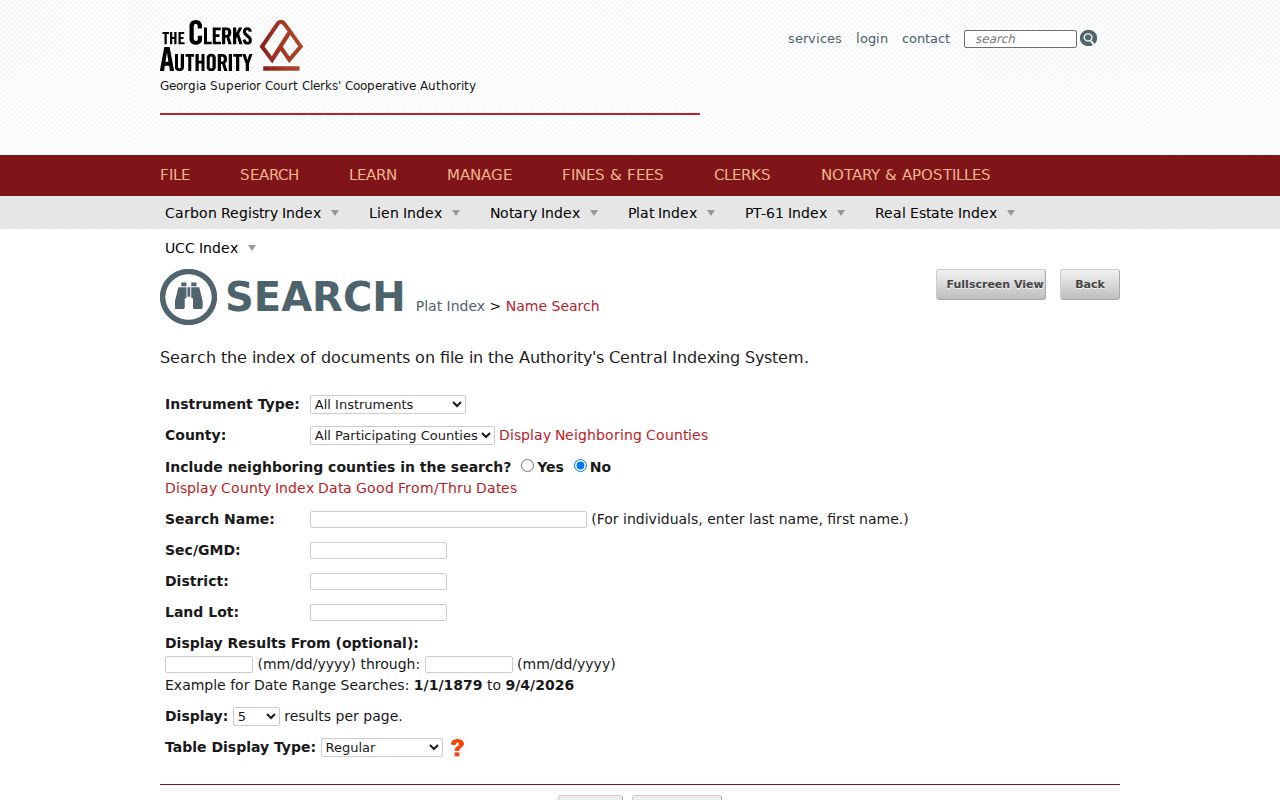
The plat interface offers precise controls. Search by name, county, land lot, district or date, and remember that a GIS outline may locate a tract but never replaces the recorded description or a survey.
Go Beyond 1905 for Older Land
Stephens County was born on August 18, 1905. Its land came from Habersham and Franklin counties. Any deed chain crossing that year must continue in the predecessor county that held the land at the time. The Georgia Archives County Records on Microfilm collection holds county deed books, tax digests and probate material, though the exact Stephens reels and book runs are worth confirming. The clerk keeps permanent paper and microfilm storage but publishes no local imaging cutover year. Ask for the original-book and microfilm inventory instead. The GSCCCA start is not the beginning. Note: For an older chain, jurisdictional continuity matters just as much as continuity in the party names.
Obtain a Stephens County Deed Copy
Start with the indexed GSCCCA image. Otherwise, contact the Clerk of Superior Court at 70 N Alexander Street, Suite 202, Toccoa. The public counter is open to walk-ins. The clerk handles plain and certified copy requests for records that never reached the online index. Copies run 50 cents per page. Confirm certification and mailing charges before ordering, and know that the separate $25 figure on county guidance is a deed filing fee, not the per-page copy charge.
Recorded, not guaranteed. Stephens County deed records show what entered the public index. They do not guarantee clear title, resolve every defect or reveal an unrecorded interest.
Monitor New Filings With FANS
Monitoring is free. The Georgia Filing Activity Notification System alerts enrolled users to qualifying future deed, lien, plat or UCC index matches. Enroll after you know the party or property. It is a watchful aid, not a chain search. The system aids monitoring but does not perform retroactive chain searches or guarantee that every questionable filing will be caught. Local reporting on deed and title fraud in Stephens County has discussed identity-verification changes for electronic self-filers, so confirm present filing practice with the clerk.
Distinguish Deeds From Liens and Security Instruments
Stephens County records cover several distinct instrument families. A conveyance deed marks a transfer of title. A security deed, by contrast, backs a debt rather than passing ownership. A lien asserts an encumbrance against the land. A plat simply depicts a recorded land division. Because these families sit in related but separate systems, a thorough Stephens County deed-records review sweeps the companion indexes without reading every filing as a change of owner.
The GSCCCA lien form adds party, instrument, county and date filters, so a name appearing in both deed and lien results deserves separate inspection of the document type and legal description. Satisfactions, releases and cancellations can matter just as much as the original entry when you ask whether a recorded burden still stands.
Handle Estates, Trusts and Entity Transfers
A deed chain can pass through unusual hands. An executor, administrator, trustee, life tenant, heir or business entity may stand in as grantor. Copy the capacity exactly as written. Search both the individual and the entity wording. Probate records may explain the fiduciary's authority, yet the deed recorded by the Superior Court Clerk remains the instrument that actually conveys land.
Entity transfers are not open-market sales by default. A quitclaim label proves nothing about the grantor's title. Keep instrument type, consideration clues, PT-61 context, parties, recording date and land description together, so every later conclusion stays tied to the actual record.
Build a Verifiable Deed Citation
Build every citation from the record itself. For each Stephens County deed, note the grantor, grantee, deed type, execution date if shown, recording date, and the book and page or instrument number. Add the legal description, image source and access date. Include a plat citation when the description references one. That trail makes the search reproducible. If the web index and the courthouse copy disagree, ask the clerk to identify the official recorded version and its correction process. The assessor and GIS can help locate the tract, but only the clerk's office handles the recorded deed.