
Build the Stephens County Chain Backward
Confirm the current parcel first, along with its newest conveyance. From there, read the transfer history in reverse. Every row must rest on a real instrument. A family story or a matching surname cannot fill a gap in the chain.
| Transfer date | Grantor to grantee | Deed type | Book and page |
|---|---|---|---|
| Newest verified recording | Prior holder to present grantee | Record the exact deed label | Copy from the index |
| Next earlier recording | Earlier holder to the prior holder | Do not confuse a security deed with a sale | Carry the citation back |
| Earlier book entry | Continue one grantor at a time | Note corrective or fiduciary wording | Use clerk books or microfilm |
No sample owners or dates appear in the timeline, and that is by design. Blank lines beat invented rows. Fill each one from GSCCCA or the Clerk of Superior Court, citing the deed behind every step.
GSCCCA Opens the Recent Stephens County Trail
The GSCCCA Real Estate name search offers Central Indexing System coverage. That coverage reaches back to January 1, 1990. Select Stephens County. Enter the current grantee's exact name. Widen the date range only if the first pass comes up thin. Instrument controls sit on the same form. Book/page plus subdivision modes give you other ways in.
Treat the index as a finding aid. Pulling images may require an account or a fee. The clerk stays the custodian of certified copies and of anything missing or older. Copies at the local office run 50 cents per page. GSCCCA carries its own account and image charges.
The official statewide deed-name form shows exactly where a recent search begins:
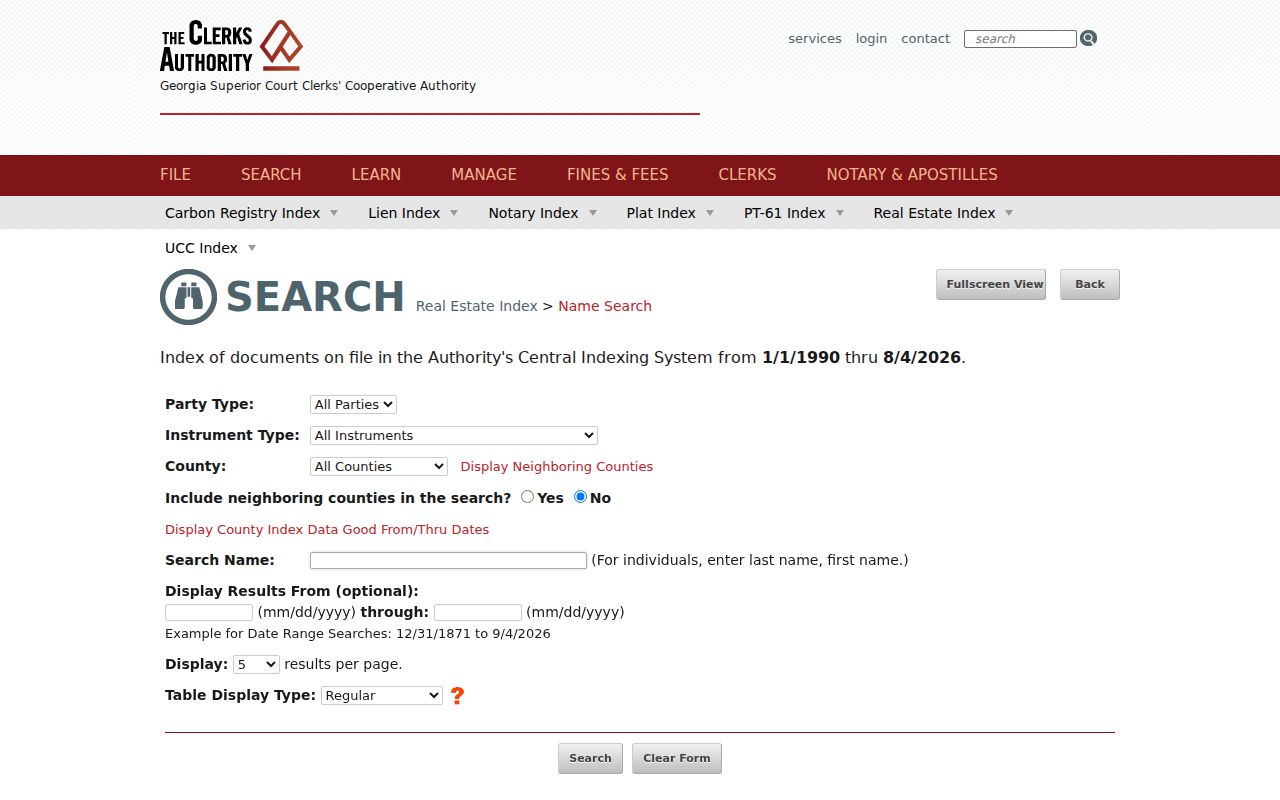
Party, county, date, and instrument controls help narrow a crowded name. Still, every result must be tied to the subject land before it enters the chain.
Walk Stephens County Deeds in Reverse
Roles drive the reverse walk. The owner who took the current deed is the grantee. Whoever conveyed it stands as grantor, and that name becomes the next grantee you search in the earlier period.
- Find the present holder's acquisition deed and verify the legal description.
- Copy the grantor's full name, deed type, execution date, recording date, and book/page.
- Search that grantor as a grantee in an earlier date range.
- Compare the new instrument's land description and plat references with the chain.
- Repeat until the online index ends, then continue at the clerk, on microfilm, or in predecessor counties.
- Grantor and grantee
- The conveying party and receiving party named in an instrument.
- Chain of title
- The linked sequence of transfers affecting the same tract.
- Reverse index
- An index organized to help trace by the receiving party while moving backward.
- Warranty and quitclaim deeds
- Different conveyance forms whose effect must be read from the recorded document, not guessed from the label alone.
Keep Previous Owners Tied to the Same Land
A shared surname proves nothing. Match district, land lot, metes-and-bounds calls, acreage, subdivision, lot, and block. Also match plat references before trusting any link. Old deeds rarely carry a modern street address. Parcel numbers can also shift after a split or a combination.
Keep execution and recording dates in separate columns. A deed signed early but recorded late will otherwise look out of sequence. Note too that a corrective instrument can fix a name or description. That fix is not a fresh arm's-length transfer.
Stephens County Plats Preserve Place
Names and addresses drift apart. A recorded plat keeps the subdivision, lot, and block framework intact. GSCCCA offers plat name and book/page searches, with land-lot and district controls built in. The clerk holds plats locally as well.
One lead is a Martin and Rice Subdivision plat. It involves lots 62 and 63. The plat was surveyed November 15, 1977, at Deed Book 1197 Page 204. Treat it only as a lead. The actual plat and deed image must confirm that citation. It must also confirm the tie to the subject property.
Heirs and Fiduciaries Can Bend the Chain
A tidy seller-to-buyer sequence can pause. A death or a fiduciary act is usually why. Probate Court records may explain an executor's or administrator's authority. The recorded deed or assent supplies the actual land-transfer link. Search the deceased owner's name variants along with the representative's formal capacity.
Assignments, releases, liens, and security deeds do not automatically change ownership. Classify each instrument before it earns a spot on the timeline.
Before 1905, Search Two More Counties
Stephens County was created in 1905 from Habersham and Franklin counties. A tract inside Stephens today may continue into one of those older deed systems. That geography is the central insight for local former-owner research.
Start from the current legal description. Determine the older jurisdiction where possible. When the boundary is unclear, search both predecessor counties. The Georgia Archives, its county microfilm, and FamilySearch guidance can supplement the courthouse books. The Toccoa-Stephens County Library and Historical Society may add directory, newspaper, or local-history context.
Where Stephens County Ownership History Continues
The online cutoff is not where the record ends. The Clerk of Superior Court keeps microfilm and permanent paper deed records, with public access at 70 N Alexander Street, Suite 202, in Toccoa. Call or write first with names, approximate dates, and any book/page you already know. When an agency record is otherwise out of reach, a focused Georgia Open Records Act request can identify the record sought.
Lawful use. Trace former owners for house history, title research, estate work, or property diligence. Never use the trail to stalk, harass, or harm a living person.
Build citations rather than a narrative guess. For a certified copy or the mechanics of one instrument, see the Stephens County deed records guide, then verify the final chain with the clerk or qualified counsel.